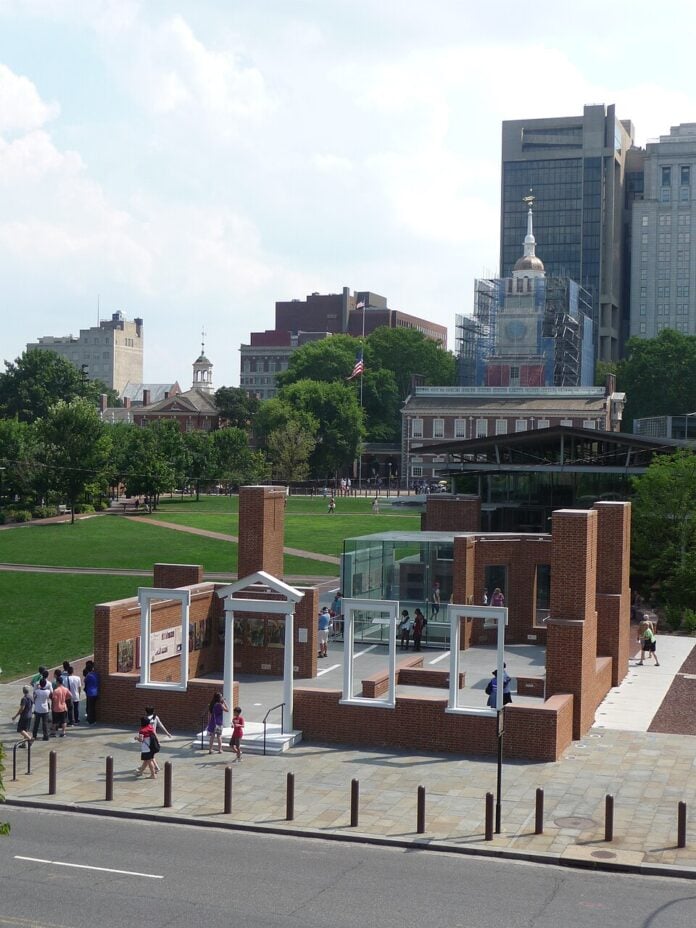
National Park Service employees dismantled exhibits honoring enslaved people at George Washington’s President’s House in Center City Thursday afternoon, following months of pressure from the Trump administration to alter historical displays deemed controversial.
The exhibits, which told the stories of nine people enslaved at Washington’s house at Sixth and Market streets, were stripped from the brick facade by Thursday evening. Monitors and text displays that provided background on the slave trade and individual histories were completely removed, though the names of the nine enslaved people etched into the building’s wall remained untouched.
Michael Coard, the criminal defense attorney who spearheaded the memorial’s installation in 2010, condemned the federal action.
“This historically outrageous and blatantly racist destruction began at around 3:30 p.m. today,” Coard said Thursday afternoon as the removal was underway.
The exhibits honored nine enslaved individuals who lived and worked at the house where Washington resided during his presidency in Philadelphia. The memorial had stood for over 15 years, providing visitors to Independence National Historical Park with historical context about slavery’s role in the founding era.
The exhibit in Philadelphia was removed after falling under a Trump administration directive that has affected historical displays at federal sites across the country. In May, Interior Secretary Doug Burgum ordered agencies to examine exhibits that he said “disparage Americans past or living.”
Displays at Smithsonian museums in Washington have also been labeled “ideological” by the White House and subjected to review. The President’s House site was not publicly identified at the time, but The New York Times reported in September that the Philadelphia slavery exhibit was among those placed on an internal list for potential removal.
City officials and advocates connected to the President’s House memorial addressed the removal after the exhibits came down, saying the panels had long provided necessary context at a site visited daily by tourists and school groups. Members of Mayor Cherelle Parker’s administration and City Council referenced the loss of that context, several describing the decision as an attempt to “whitewash American history.”
At Independence National Historical Park, visitors encountered gaps where interpretive displays once stood, leaving fewer explanations of the enslaved people tied to the site. Groups involved in the memorial’s creation said they plan to continue pressing their objections publicly and through the courts.
The President’s House site has long been at the center of debate over how slavery is addressed alongside America’s founding history. George Washington lived at the Sixth and Market streets location during his presidency in Philadelphia, bringing enslaved people from Mount Vernon to work in the household, a history that went largely unacknowledged at the site for decades.
The memorial was installed in 2010, following years of public pressure after archaeological work and archival research confirmed the presence of enslaved people at the residence. Its planning drew disagreement over design, language, and how prominently slavery should be featured at a site adjacent to the Liberty Bell, before moving forward as a joint city and federal project within Independence National Historical Park.
National Park Service officials have said the removal falls under a broader review of interpretive material at federal sites. An Interior Department spokesperson said the agency is acting under a directive to reassess exhibits for “accuracy” and “consistency.”
At the President’s House, the change is night and day for visitors. The interpretive panels explaining the lives of the enslaved people connected to the site are gone, leaving names engraved into the wall without the surrounding context. One visitor told reporters she was “heartbroken,” saying, “You show all of it — the good, the bad, and the ugly.”
The site remains open as part of Independence National Historical Park, but its interpretation now focuses more narrowly on the early federal government.