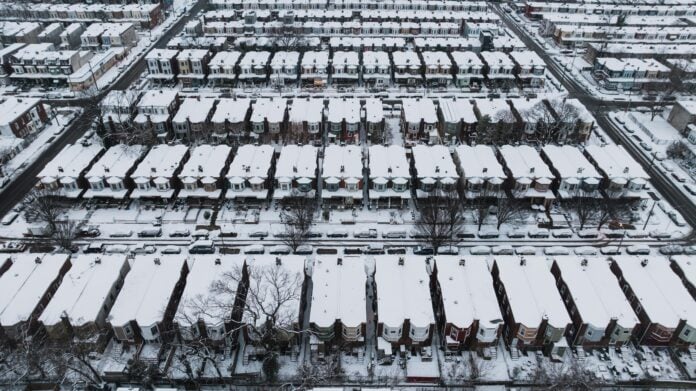
Philadelphia and much of eastern Pennsylvania are under escalating emergency measures as a powerful winter storm brings heavy snow, high winds, and dangerous travel conditions across the region.
Mayor Cherelle L. Parker declared a Disaster Emergency Sunday as forecasts called for significant snowfall and blizzard conditions through Monday.
“The declaration of a Disaster Emergency will allow Philadelphia to more effectively fight this large and dangerous storm as it rolls in,” Parker said. “It is absolutely vital that the City be able to mobilize and utilize all available resources to address this extreme snow emergency and protect the health, safety, property, and welfare of Philadelphia residents.”
The declaration followed updated forecasts from the National Weather Service predicting up to 18 inches of snow, along with dangerous wind conditions. A Blizzard Warning was issued for possible heavy snow and high wind gusts that could make travel dangerous and cause power outages.
As conditions intensified Sunday afternoon, the Pennsylvania Department of Transportation and the Pennsylvania Turnpike Commission implemented vehicle restrictions across major eastern highways.
Tier 1 restrictions began at 3 p.m. on interstates, including I-76, I-78, I-80 (from I-81 to New Jersey), I-81, I-83, I-84, I-95, I-99, I-283, I-295, I-380, I-476, I-676, Route 33, and U.S. 22 (from I-78 to New Jersey), along with portions of the Turnpike system.
Under Tier 1:
- Tractors without trailers
- Lightly loaded or unloaded trailers
- Passenger vehicles towing trailers
- RVs and motorhomes
- Motorcycles
- School and commercial buses without chains or approved traction devices
At 6 p.m., Tier 4 restrictions took effect on several eastern roadways, including the Schuylkill Expressway (I-76), I-78, I-80 (from I-81 to New Jersey), I-84, I-95, I-295, I-380, I-476, I-676, Route 33, U.S. 22 (from I-78 to New Jersey), and portions of the Turnpike system.
Under Tier 4, no commercial vehicles are permitted, with additional restrictions on buses, motorcycles, RVs, and passenger vehicles towing trailers. Speed limits may be reduced to 45 mph where restrictions apply.
Officials urged drivers to monitor forecasts and avoid unnecessary travel. Roadway conditions are available at 511PA.com, through the 511PA app, or by calling 5-1-1.
It remains unclear when restrictions will be lifted.
Snow moved into the city Sunday afternoon, changing over from rain around 3 p.m., creating whiteout conditions along the Schuylkill River and cloaking the skyline.
A Blizzard Warning remains in effect through 6 p.m. Monday.
Snowfall totals are forecast between 10 and 18 inches across the metro, with wind gusts potentially reaching 45 mph, according to Zack Cooper, meteorologist at the National Weather Service’s Mount Holly office.
“The combination of heavy snow, blowing snow, and gusty winds could result in trouble for crews to quickly clear the roads and power outages,” Cooper said. “Overall, it’s a serious event.”
Travel conditions are expected to be “very difficult to impossible” as snowfall rates could exceed 2 inches per hour.
Philadelphia has deployed more than 1,000 personnel and over 800 trucks and pieces of equipment to fight the storm, including triaxle snowplows, sanitation compactors mounted with plows, pickup trucks with salt spreaders, and smaller equipment for narrow streets.
The city’s Emergency Operations Center has been activated to coordinate response efforts.
The primary goal during the storm, officials said, is keeping streets passable for Police, Fire, and EMS. Snow emergency routes and major thoroughfares are prioritized before crews expand into neighborhood streets.
Residents are urged to avoid unnecessary travel and allow crews space to operate.
The storm has triggered sweeping operational changes across the city:
- All City administrative buildings, recreation centers, Free Library branches, and Courts are closed Monday.
- The School District of Philadelphia is virtual Monday.
- All City Health Centers are closed Monday.
- Trash and recycling collections are suspended Monday and Tuesday, with a two-day delay for the remainder of the week.
- No collections will occur in rear driveways during the week of Feb. 23.
- Second trash collections are suspended for the week.
- Sanitation Convenience Centers remain open 8 a.m. to 6 p.m.
SEPTA service will operate “as long as it’s safe to operate,” according to a news release.
At Philadelphia International Airport, airlines have adjusted schedules. For Monday, A-West, B, and C ticketing and checkpoints will be closed, while A-East, D/E, and F will remain open.
The Office of Homeless Services declared a Code Blue beginning at 3 p.m. Sunday, adding extra shelter capacity. Warming centers have opened, including the Hub of Hope beneath Dilworth Park.
For many Philadelphians, the storm carries echoes of last month’s severe weather.
“It just melted like two days ago, and now it’s déjà vu. So I’m not so happy about it,” said Amanda Kahn of Rittenhouse Square.
Emily Niedermayer of Rittenhouse Square said, “I like a little bit of snow, but last time the city really struggled to clear it in our neighborhood, so I hope they’re a little more responsive now.”
Not everyone stayed indoors. On the Philadelphia Museum of Art steps, James McFadden of Logan Square continued training.
“I’m training for an Ironman. I still had to get my run in, so no excuses,” he said. “Gotta come out in the snow, and it’s a beautiful night, so great time to enjoy the weather and see some of the views around the city.”
The heaviest snowfall is expected to taper off around noon Monday, though lighter snow and gusty winds could persist into the evening.
Gov. Josh Shapiro has declared a state of emergency through Monday and urged residents to take the storm “seriously.” The National Guard is on standby.
Philadelphia has already spent an estimated $59 million on storm-related costs this winter, including operating warming centers for 25 straight days and spreading more than 15,000 tons of salt during the previous storm.
Whether the city’s response this time avoids similar disruption will become clear once plows make their way through neighborhoods and normal services resume.