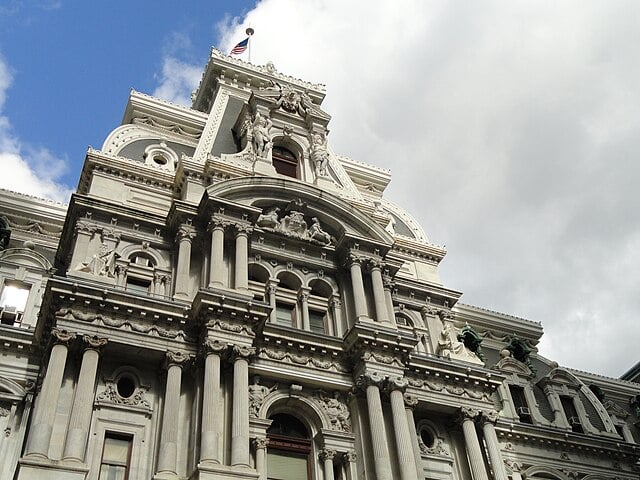
Hundreds of demonstrators gathered outside Philadelphia City Hall on Monday evening to protest U.S. military strikes on Iran, joining a nationwide day of action organized by anti-war groups.
Organizers said rallies were held in more than 60 cities across the country, calling on the United States to halt military operations and avoid deeper involvement in the escalating conflict overseas.
The Philadelphia protest was organized by the Party for Socialism and Liberation Philly, the ANSWER Coalition, and Socialist Alternative. Demonstrators assembled in front of City Hall, carrying signs and chanting against the military campaign.
Participants also criticized federal spending priorities, arguing that government resources should be directed toward domestic programs rather than foreign conflicts.
The protests took place as Congress prepares to debate presidential authority to continue military operations in Iran without legislative approval. Activists said the demonstrations were intended to show public opposition to the strikes and pressure lawmakers to limit executive war powers.
The rallies also reflected concerns about the potential length of the conflict and the United States’ role in escalating tensions in the Middle East. Earlier in the day, President Donald Trump defended the decision to launch strikes against Iran, saying the United States faced growing security risks.
“The regime already had missiles capable of hitting Europe and our bases, both local and overseas, and would soon have had missiles capable of reaching our beautiful America,” Trump said, adding that the country was “nearly under threat.”
The president said the military operation could last four to five weeks.
The demonstrations in Philadelphia occurred as fighting between Iran, Israel, and the United States intensified across the Middle East.
Over the weekend, coordinated U.S. and Israeli strikes targeted senior Iranian leadership and military sites, and Iranian state media later confirmed the death of Supreme Leader Ayatollah Ali Khamenei in the attacks.
Iran responded with missile and drone attacks targeting Israel and U.S. military installations in the region, with casualties reported in multiple countries, including Israel and several Gulf states.
The strikes also triggered wider regional tensions, as Hezbollah launched attacks on Israel and Israeli forces responded with additional airstrikes.
The escalating conflict has also disrupted transportation and energy markets across the region.
Air travel has been affected in several Gulf countries, and global oil prices rose sharply amid concerns that the fighting could threaten shipping through the Strait of Hormuz, one of the world’s most critical energy corridors.